DJ Mixing Board Essentials for Live Audio
Discover how a DJ mixing board shapes live audio performances. Learn about channel layouts, EQ controls, and essential features for modern sound blending.
Table of Contents
- The Core Anatomy
- Audio Routing and Signal Flow
- Creative Effects and Sound Shaping
- Choosing the Right Equipment
- Questions from Our Readers
- Equipment Comparison
- Practical Tips
Article Snapshot
A DJ mixing board is an electronic audio console used to blend, route, and manipulate multiple sound sources during a live performance. It provides dedicated controls for volume, equalization, and effects, allowing performers to seamlessly transition between tracks and shape the overall sonic energy of a venue.
By the Numbers
- Typical modern club-oriented setups feature 4 main input channels (The DJ Hookup, 2024)[1].
- Standard channel strips provide 3 EQ bands per channel for precise frequency control (Digital DJ Tips, 2024)[2].
- Recent industry roundups evaluate around 10 mixer models to cover varying budgets and styles (DJ.Studio, 2026)[3].
The DJ mixing board is the central hub of any live music performance, relying on seamless audio transitions to keep the crowd engaged. At the heart of this process, the console transforms isolated tracks into a continuous, dynamic auditory experience. While early broadcasters used rudimentary volume controls, modern performers require sophisticated tools to manage complex signal flows. As Phil Morse, Founder and Tutor at Digital DJ Tips, notes, “Every DJ setup has some kind of mixer, because without a mixing board you simply can’t blend multiple sound sources into a coherent performance” (Digital DJ Tips, 2024)[2]. This article explores the fundamental architecture of these consoles, detailing how channel faders, equalization bands, and routing matrices work together. Whether you are evaluating entry-level gear or professional club installations, understanding these components is essential for mastering live sound manipulation.
The Core Anatomy of a DJ Mixing Board
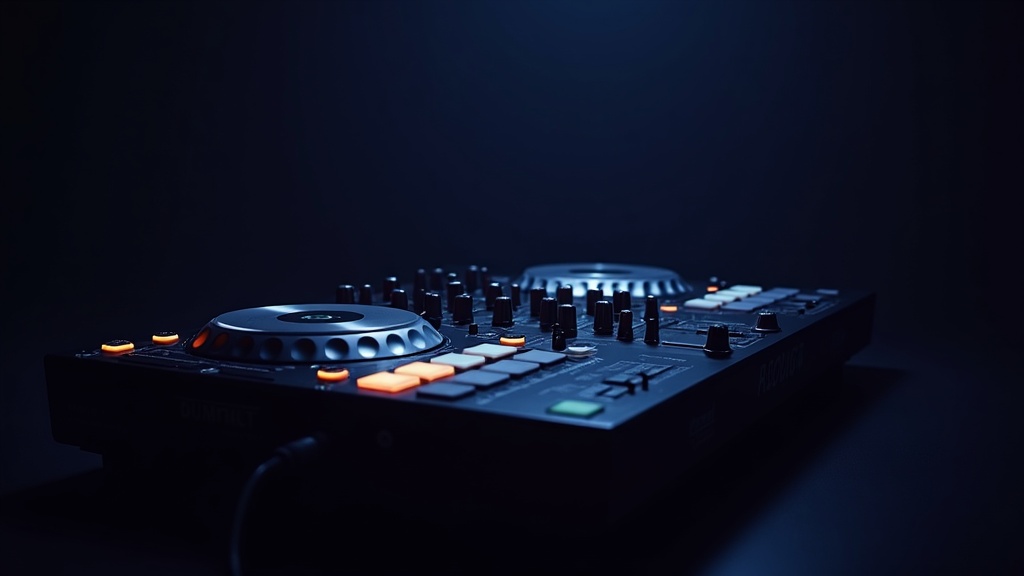
A standard audio mixing console is divided into distinct channel strips, each governing an individual sound source. When a signal enters from turntables, CDJs, or a digital soundcard, it first passes through the trim knob. This initial gain staging ensures the input volume matches the console’s optimal operating level, preventing distortion while maintaining a strong signal-to-noise ratio. Following the trim, the audio flows through the equalization section. Most professional units feature a three-band EQ, providing dedicated knobs for high, mid, and low frequencies. This allows the performer to carve out sonic space, ensuring that the basslines of two overlapping tracks do not clash and cause muddy low-end distortion.
Below the EQ section, the channel fader dictates the final volume of that specific source before it reaches the master bus. The physical placement of these faders is deliberate, enabling rapid adjustments during live sets. At the bottom of the console lies the crossfader, a horizontal slider that governs the balance between two selected channels. Scratch artists often prefer specialized crossfaders with adjustable tension and cut-in distance, allowing for rapid, percussive audio cuts. Meanwhile, the master volume section controls the overall output sent to the main venue speakers, while a separate booth monitor output feeds the performer’s on-stage speakers. VU meters provide crucial visual feedback, displaying the decibel levels of both individual channels and the master output to prevent clipping. Understanding this physical layout is the first step toward achieving clean, professional audio blending.
Audio Routing and Signal Flow
Managing Inputs and Outputs
The true power of a DJ mixing board lies in its internal routing matrix. Modern units accept a wide variety of inputs, including traditional RCA connections for analog turntables, line-level inputs for media players, and digital connections like USB or S/PDIF. Many contemporary models also integrate a multi-channel audio interface, allowing direct connection to a laptop without requiring an external soundcard. This integration streamlines the setup process and reduces the number of cables needed on stage.
Signal flow extends beyond the main outputs. Advanced consoles feature auxiliary sends and returns, which route a copy of the audio signal to external effects units. This parallel processing capability means a performer can apply heavy reverb or delay to a specific track without altering the dry signal. Furthermore, dedicated microphone channels include their own EQ and talkover functions, automatically ducking the music volume when the performer speaks.
Internal routing also facilitates complex cueing systems. The headphone cue button, located on each channel strip, allows the performer to listen to an upcoming track in their headphones before it is broadcast to the audience. This pre-listening capability is fundamental for beatmatching, as it enables the artist to align the tempo and phase of the next song privately. Some high-end models offer split-cue functionality, separating the master output in one ear and the cued channel in the other, providing maximum clarity in loud environments. Just as industrial sectors rely on specialized equipment like a comprehensive grout mixing guide for mining to handle heavy materials, audio professionals depend on precise routing matrices to handle complex signal flows.
Creative Effects and Sound Shaping
Beyond basic volume and frequency control, a DJ mixing board serves as a dynamic instrument for real-time sound design. Built-in effects units have become a standard feature, offering processors like high-pass filters, low-pass filters, flangers, and echoes. A filter knob is often centrally located, allowing the performer to sweep frequencies across the master output or a specific channel. Sweeping a high-pass filter gradually removes the bass and lower midrange, creating tension before a track drops back in with full frequency impact.
David Michael, Founder of Passionate DJ, explains that “The modern DJ mixer is more than a volume control; it’s a creative instrument that shapes the energy of the room through EQ, effects, and routing decisions” (Passionate DJ, 2026)[4]. Many contemporary consoles include beat-synced effects, which automatically align delay and echo timings to the tempo of the playing track. This ensures that rhythmic effects remain musically relevant, even when the performer transitions between songs with different tempos.
Furthermore, performance pads and loop controls are increasingly integrated directly into the mixer section. These tactile buttons allow artists to trigger samples, hot cues, or instant loops without touching the primary playback devices. For those interested in the psychological impact of these performances, studying neuromarketing books can reveal how rhythmic audio loops and frequency shifts influence crowd engagement and emotional responses. The integration of these creative tools transforms the console from a simple utility into a central hub for musical expression, giving the artist granular control over the sonic texture of their set.
Choosing the Right Equipment
Selecting the appropriate DJ mixing board depends heavily on the performer’s specific style, venue requirements, and budget. Beginners often start with two-channel controllers, which combine the mixer and playback decks into a single, compact unit. These entry-level models prioritize ease of use and software integration, making them ideal for learning fundamental skills. As the Pioneer DJ Product Team advises, “A dedicated DJ mixer gives beginners a clearer path to learning core skills like beatmatching, EQing, and cueing, because each function is laid out with performance in mind” (Pioneer DJ, 2024)[5].
As artists progress to club and festival environments, the demand for robust build quality and expanded connectivity increases. Professional club mixers typically feature four channels, high-quality analog summing circuits, and replaceable faders. The physical construction must withstand rigorous nightly use, with reinforced knobs and durable PCB boards. According to gear reviewers at The DJ Hookup, “When you’re choosing a DJ mixing board today, four channels, solid build quality, and reliable filters or effects are the baseline for club and festival use” (The DJ Hookup, 2024)[1].
Scratch DJs, conversely, prioritize different features. They require mixers with extremely short crossfader cut-in distances, adjustable fader tension, and a layout that keeps the turntables as close to the crossfader as possible. Budget also plays a significant role; while premium analog mixers offer superior sound quality and tactile feedback, digital alternatives provide extensive software integration at a lower price point. Evaluating these factors ensures that the chosen equipment aligns perfectly with the artist’s technical demands and performance goals. For those who appreciate precision in other areas of life, selecting the perfect precision-cut gemstones requires a similar eye for detail, cut, and structural integrity.
Questions from Our Readers
What is the difference between a club mixer and a scratch mixer?
Do I need a standalone mixer if I use a DJ controller?
How does the crossfader curve adjustment work?
Why are VU meters important on a mixing console?
Equipment Comparison
Selecting the right DJ mixing board requires understanding the distinct advantages of different mixer categories. While digital controllers offer convenience, traditional analog consoles deliver superior sound staging and tactile feedback. The table below outlines the primary differences between entry-level controllers, professional club mixers, and specialized scratch mixers to help guide your purchasing decision.
| Feature | Entry-Level Controller | Professional Club Mixer | Specialized Scratch Mixer |
|---|---|---|---|
| Channel Count | 2 Channels | 4 Channels | 2 Channels |
| Audio Processing | Digital / Software | Analog Summing | Analog / Digital Hybrid |
| Crossfader Type | Standard Linear | Smooth / Replaceable | Adjustable Tension / Sharp Cut |
| Primary Use Case | Bedroom / Mobile | Clubs / Festivals | Turntablism / DMC |
Practical Tips
Mastering a DJ mixing board requires consistent practice and a methodical approach to signal management. First, always establish proper gain staging before touching the channel faders. Use the trim knob to align the input volume so that the VU meters peak just below the red zone during the loudest parts of the track. This prevents cumulative distortion when multiple channels are active simultaneously.
Second, utilize the headphone cue system effectively. Practice beatmatching entirely in your headphones before bringing the new track into the master output. Rely on the split-cue function if your mixer supports it, as this provides the clearest separation between the playing track and the incoming audio.
Third, experiment with EQ transitions rather than relying solely on volume faders. Swapping the bass frequencies between two tracks creates a much cleaner transition than simply crossfading the overall volume. Finally, maintain your hardware regularly. Clean the fader tracks with compressed air and apply specialized lubricants to ensure smooth movement, extending the lifespan of your equipment and preventing audio dropouts during critical performance moments.
Wrapping Up
A high-quality DJ mixing board remains the central nervous system of any live electronic music performance. By mastering channel layouts, understanding complex routing matrices, and utilizing creative effects, performers can elevate their sets from simple playlists to dynamic auditory journeys. Whether you are upgrading to a four-channel club standard or refining your scratch techniques, investing time in understanding your hardware yields immediate improvements in sound quality and mixing precision. Ready to appreciate meticulous craftsmanship in other areas? Explore our detailed guide on selecting a flawless topaz gemstone to see how precision applies across all creative disciplines.
Sources & Citations
- Best DJ Mixers for 2024 – Hands-On Review. The DJ Hookup.
https://thedjhookup.com/blog/reviews/best-dj-mixer/ - Understanding Your Mixer. Digital DJ Tips.
https://www.digitaldjtips.com/rock-the-dancefloor/understanding-your-mixer/ - Best DJ Mixers in 2026: The Ultimate Guide. DJ.Studio.
https://dj.studio/blog/best-dj-mixers - Best DJ Mixers in 2026: The Ultimate Guide. Passionate DJ.
https://www.youtube.com/watch?v=MUsRC4H5hIQ - Equipment Recommended for Beginner DJ. Pioneer DJ.
https://www.pioneerdj.com/en/landing/beginner-dj-equipment/