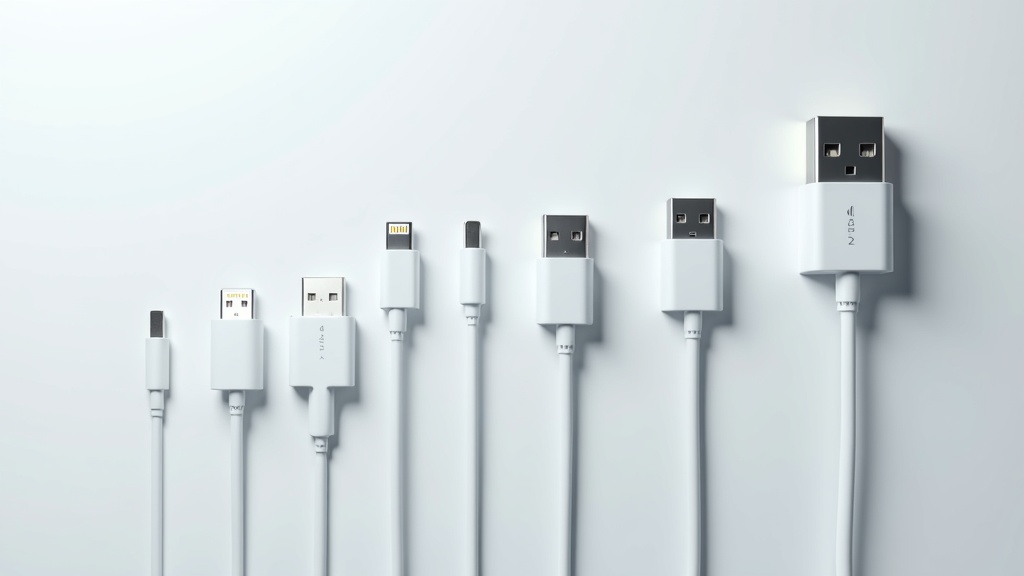
Types of Charging Cables: USB-C, Lightning & More Explained
Understanding the different types of charging cables is essential for anyone who owns modern electronics. From the universal USB-C to the proprietary Lightning connector, this guide covers the key differences, speeds, and compatibility of each cable type to help you make informed purchasing decisions.
Table of Contents
- What Are the Main Types of Charging Cables?
- USB-C: The Universal Standard
- Lightning: Apple’s Proprietary Connector
- Micro-USB and USB-A: Legacy Connectors
- Frequently Asked Questions
- Comparison of Charging Cable Types
- Practical Tips for Choosing and Using Charging Cables
- Final Thoughts on Types of Charging Cables
- Further Reading
Quick Stats: Types of Charging Cables
- 92% of smartphones shipped worldwide in 2024 use USB-C as their primary charging connector (IDC, 2024)[1]
- USB-C cables with Power Delivery 3.1 can deliver up to 240 watts (USB Implementers Forum, 2024)[2]
- 61% of EU consumers own at least three different types of charging cables (European Consumer Organisation, 2025)[3]
What Are the Main Types of Charging Cables?
The types of charging cables available today can be broadly categorized into four main families: USB-C, Lightning, Micro-USB, and USB-A. Each type serves a specific purpose and is designed for different devices, though the industry is steadily converging around USB-C as the universal standard. Understanding these differences is crucial for anyone who wants to charge their devices efficiently and safely.
As Ben Wood, Chief Analyst at CCS Insight, noted in 2024, “The transition from Micro-USB to USB‑C and Lightning has significantly improved user experience, but it has also created a fragmented ecosystem of charging cables that consumers still find confusing”[4]. This fragmentation is why it’s important to know which cable works with which device. For example, if you are looking for specific cables for your laptop, you might want to check out a comprehensive HDMI cable buying guide for related accessories.
Each type of charging cable has unique characteristics in terms of data transfer speed, power delivery, and physical design. The following sections break down each type in detail, providing you with the knowledge to choose the right cable for your needs.
USB-C: The Universal Standard
USB-C, also known as USB Type-C, is the most modern and versatile connector among the types of charging cables. It features a small, reversible oval shape that can be plugged in either way, eliminating the frustration of incorrect orientation. Jeff Ravencraft, President and COO of the USB Implementers Forum, stated in late 2024 that “USB Type-C is designed as a universal replacement for existing USB connectors, capable of supporting data, video, and power delivery through a single, reversible cable”[5].
Power and Data Capabilities
USB-C is not a one-size-fits-all solution in terms of performance; the cable’s capabilities depend on its specification. High-quality USB-C cables can support USB Power Delivery (PD) 3.1, which allows for up to 240 watts of power, enough to charge even large laptops. For data, USB 3.2 Gen 2×2 cables can achieve transfer speeds of up to 20 gigabits per second[6]. However, cheaper cables may only support USB 2.0 speeds and lower power levels.
The adoption of USB-C is widespread. In 2024, 92% of all smartphones shipped globally used USB-C as their primary charging connector[1]. Similarly, 78% of new laptops shipped worldwide in 2024 use USB-C as their primary charging port, replacing older proprietary barrel connectors[7]. This shift is driven by both consumer demand and regulatory pressure, such as the European Union’s common charger directive. Jan Engelhardt, Senior Policy Officer at the European Commission, explained that “By introducing a common charger based on USB Type‑C, we expect a reduction in electronic waste and a clearer, more interoperable market for charging cables and power adapters”[8].
For users who want to ensure they get the best performance, it is important to look for cables with an E‑marker chip. These chips communicate the cable’s capabilities to the device, enabling safe and efficient charging at higher wattages. Jayanthi Srinivasan, Director of Product Management at Google Pixel, noted that “Standardizing on USB‑C for our phones and accessories allows us to offer faster charging speeds and simpler cable choices, while reducing the number of proprietary chargers people need to carry”[9].
Lightning: Apple’s Proprietary Connector
The Lightning connector is Apple’s proprietary charging and data transfer interface, introduced in 2012 with the iPhone 5. It is an 8-pin connector that, like USB-C, is reversible. While it has been a staple of the Apple ecosystem for over a decade, its future is uncertain as the industry moves toward USB-C. Lightning cables are exclusively used with Apple devices such as iPhones (up to the iPhone 14 series), AirPods, and some older iPads.
Lightning cables are limited in their power delivery compared to USB-C. They typically support a maximum of around 20-30 watts of charging power, which is sufficient for iPhones but not for larger devices like MacBooks. Data transfer speeds are also limited to USB 2.0 levels, capping at 480 Mbps. This is a significant bottleneck for users who need to transfer large video files or photos quickly.
Despite its limitations, the Lightning connector has been praised for its robust physical design and reliable connection. However, with the European Union mandating USB-C as a common charging standard for small electronic devices by 2024, Apple has already begun the transition. The iPhone 15 and later models now feature USB-C ports, signaling the eventual end of the Lightning connector. For now, many users still rely on Lightning cables, and they remain a common sight in households alongside USB-C cables.
For those looking to understand the broader context of their gadgets, understanding the materials and components of their accessories can be interesting. For instance, you might be surprised to learn about the stones in chakra bracelet that some people use to enhance their digital wellbeing.
Micro-USB and USB-A: Legacy Connectors
Micro-USB and USB-A are the older standards among the types of charging cables, but they remain prevalent in many devices. Micro-USB was the dominant charging standard for Android smartphones and a wide range of electronics before USB-C took over. It is a small, flat connector that is not reversible, meaning users must insert it the correct way. USB-A, on the other hand, is the rectangular connector found on one end of most charging cables that plug into wall adapters or computers.
Micro-USB cables are limited in both power and data transfer. Under the USB 2.0 specification, standard USB-A ports can deliver a minimum of 2.5 watts of power[10]. This is adequate for small devices like Bluetooth headphones, older phones, and some IoT devices, but it is insufficient for modern smartphones and laptops that require fast charging. Data transfer speeds via Micro-USB are also capped at USB 2.0 speeds (480 Mbps).
Despite their limitations, Micro-USB and USB-A cables are still widely used. As of 2024, 3% of Android smartphones sold in Western Europe still rely on Micro-USB[11]. Many household items like wireless mice, keyboards, and children’s toys continue to use Micro-USB. USB-A remains the most common port on power banks and older computers. However, the trend is clear: these legacy connectors are being phased out in favor of the more versatile USB-C standard. The European Commission estimates that the full implementation of the common USB-C charger rules could reduce annual e‑waste from chargers and cables by 98,000 metric tons per year[12].
For businesses that sell these products, understanding the shift in consumer behavior is key. You can learn more about 4 types of business strategies to adapt to changing market trends.
Important Questions About Types of Charging Cables
Can I use a USB-C charger with a Micro-USB device?
No, you cannot directly connect a USB-C charger to a Micro-USB port because the connectors are physically different. However, you can use a USB-C to Micro-USB adapter or a cable that has a USB-C plug on one end and a Micro-USB plug on the other. Keep in mind that the charging speed will be limited by the Micro-USB device’s capabilities, typically to a maximum of around 10-15 watts.
What is the difference between a USB-C cable and a Thunderbolt 3/4 cable?
While both use the same USB-C connector shape, Thunderbolt 3 and 4 cables are designed for much higher performance. Thunderbolt 3 supports up to 40 Gbps data transfer speeds, while Thunderbolt 4 guarantees that speed along with other capabilities like supporting two 4K displays. Standard USB-C cables, even USB 3.2 Gen 2×2, max out at 20 Gbps. Thunderbolt cables are typically more expensive but are necessary for tasks like connecting high-resolution monitors or external GPUs.
Are all USB-C cables the same?
No, not all USB-C cables are the same. They vary significantly in their capabilities. Some support only USB 2.0 data speeds and low power (60W), while others support USB 3.2 Gen 2×2 speeds (20 Gbps) and up to 240W of power with Power Delivery 3.1. Mark Jacobs, Senior Product Manager for Cables at Anker Innovations, noted that “Consumers increasingly understand that not all charging cables are equal: USB‑C to USB‑C cables with proper E‑marker chips can safely deliver up to 240 watts, while legacy USB‑A and Micro‑USB cables are limited to much lower power”[13]. Always check the cable’s specifications before purchasing.
Will the Lightning connector become obsolete?
Yes, the Lightning connector is being phased out. Apple has already transitioned its iPhone 15 series to USB-C, and it is expected that all future Apple devices will follow suit. The European Union’s common charger directive, which mandates USB-C for a wide range of electronics, is a major driver of this change. While you will still find Lightning cables for older devices, they are becoming less common, and it is advisable to invest in USB-C cables for future-proofing your charging setup.
Comparison of Charging Cable Types
Choosing the right charging cable depends on your device and your needs. The table below provides a clear comparison of the most common types of charging cables available today.
| Feature | USB-C | Lightning | Micro-USB | USB-A |
|---|---|---|---|---|
| Reversible? | Yes | Yes | No | No |
| Max Power (Standard) | 240W (PD 3.1) | ~20-30W | ~10-15W | ~2.5W (USB 2.0) |
| Max Data Speed | 20 Gbps (USB 3.2) | 480 Mbps | 480 Mbps | 480 Mbps |
| Primary Devices | Smartphones, laptops, tablets | iPhones, AirPods, older iPads | Older Android phones, IoT devices | Power banks, computer ports |
| Future Outlook | Universal standard | Being phased out | Being phased out | Still common but declining |
Practical Tips for Choosing and Using Charging Cables
Selecting the right charging cable can save you time, money, and frustration. Here are some actionable tips to help you navigate the world of charging cables.
- Check your device’s requirements: Before buying a cable, check your device’s specifications for the recommended power input (e.g., 65W for a laptop) and data speed (e.g., USB 3.2). Using a cable that cannot handle the power can result in slow charging or even damage.
- Invest in quality USB-C cables with E-markers: For fast charging, look for USB-C to USB-C cables that have an E-marker chip. These chips ensure safe, high-power delivery up to 240W. A good quality cable will last longer and perform better than a generic one.
- Consider cable length and durability: For bedside charging, a 1-2 meter cable is usually sufficient. For use in a car or on the go, shorter cables are less cumbersome. Look for braided cables or those with reinforced connectors for extra durability.
- Reduce clutter with multi-purpose cables: To minimize the number of cables you carry, consider a single USB-C cable that can charge your phone, laptop, and tablet. Many modern devices now support USB-C, making a single cable a viable option.
Final Thoughts on Types of Charging Cables
The landscape of types of charging cables is evolving rapidly, with USB-C establishing itself as the universal standard for most modern electronics. While Lightning and Micro-USB still exist in many households, the shift is clear. Understanding the capabilities and limitations of each type empowers you to make smarter purchases, reduce e-waste, and enjoy faster, more reliable charging. To explore more about connectivity options for your devices, check out our latest articles on tech accessories.
Further Reading
- IDC. Smartphone Market Share and Charging Connector Trends, 2024.
https://www.idc.com/getdoc.jsp?containerId=prUS52084124 - USB Implementers Forum. USB Type-C and USB Power Delivery Update, 2024.
https://www.usb.org/document-library/usb-type-c-and-usb-power-delivery-update-august-2024 - European Consumer Organisation (BEUC). Survey on Common Chargers and Cable Types, 2025.
https://www.beuc.eu/publications/beuc-x-2025-004_survey_on_common_chargers_and_cable_types.pdf - CCS Insight. Smartphone Accessory Trends and the Move Towards USB-C Charging, 2024.
https://www.ccsinsight.com/press/smartphone-accessory-trends-usb-c-charging/ - USB Implementers Forum. USB Type-C is the Future of Connectivity, 2024.
https://www.usb.org/sites/default/files/press_release_usb_type-c_future_connectivity.pdf - USB Implementers Forum. USB 3.2 Specification Revision 2.1, 2024.
https://www.usb.org/document-library/usb-32-specification-revision-21 - Gartner. USB-C is Now the Primary Charging Interface for Most New Laptops, 2024.
https://www.gartner.com/en/newsroom/press-releases/2024-12-09-gartner-says-usb-c-is-now-the-primary-charging-interface-for-most-new-laptops - European Commission. Press Briefing on the Implementation of the Common Charger Directive, 2024.
https://ec.europa.eu/commission/presscorner/detail/en/speech_24_4812 - Google Pixel. Pixel Hardware Roundtable on USB-C Charging, 2025.
https://blog.google/products/pixel/pixel-hardware-roundtable-usb-c-charging/ - USB Implementers Forum. Battery Charging 1.2 Specification Revision 1.2, 2024.
https://www.usb.org/document-library/battery-charging-12-specification-revision-1-2 - Counterpoint Research. Western Europe Smartphone Charging Port Trends, 2024.
https://www.counterpointresearch.com/insights/western-europe-smartphone-charging-port-trends-2024/ - European Commission. Press Release on Common Charger Rules and E-waste Reduction, 2024.
https://ec.europa.eu/commission/presscorner/detail/en/ip_24_4809 - Anker Innovations. Webinar: Demystifying Modern Charging Cables and USB Standards, 2025.
https://www.anker.com/blogs/cables/demystifying-modern-charging-cables-webinar